

Real Wood Floors, Chosen for How Southern California Actually Behaves
Hardwood is the floor most people picture when they imagine a finished room. It is also the floor most often chosen on looks alone and regretted for reasons that have nothing to do with looks — a plank that cups over a concrete slab, a glossy finish that shows every speck of dust, a species that dents under a dining chair.
In Los Angeles, the decision is less about which wood you like and more about how wood behaves here. Most homes and light commercial buildings put up since about 1950 sit on a concrete slab. Interior air swings from marine-layer damp to Santa Ana dry within days. Sun comes through large windows at an intensity that will change the tone of any wood floor over time. Those three conditions should shape the specification before a single colour is considered.
This page explains what hardwood flooring is, how solid and engineered construction differ, which species and finishes suit Los Angeles homes and commercial spaces, and what to check before buying. Mill Sales has supplied flooring across Los Angeles for more than fifty years as a family-owned wholesale supplier, buying direct from leading manufacturers and taking on closeouts and discontinued lines. You can browse the full hardwood catalog at any time, or read on to work out what you are looking for first.
What Is Hardwood Flooring?
Hardwood flooring is any floor whose visible wear surface is real sawn timber. That is the distinction that matters, because several popular floors imitate wood without containing any. Laminate uses a photographic layer over a fibreboard core, and luxury vinyl uses a printed film over a vinyl or rigid core. Both can look convincing and both have real advantages in wet areas — but only hardwood gives you actual wood grain, and only hardwood can be sanded back and refinished rather than replaced.
Hardwood comes in two constructions, and almost every decision downstream depends on which one you are working with.
- Solid hardwood is a single piece of timber, traditionally around three-quarters of an inch thick, milled with a tongue and groove. It is all wood, top to bottom, which means it can be refinished many times over a long life — and also means it expands and contracts with every change in humidity.
- Engineered hardwood is a genuine timber wear layer bonded over a core of cross-laminated plywood or high-density fibreboard. The layers of the core run in opposing directions, so the plank resists the movement that a solid board cannot. The surface is still real wood; it is the construction underneath that differs.
Both are hardwood. Neither is a compromise. They simply suit different buildings, and in this market that difference is decisive.
Get in touch
Solid or Engineered Hardwood: Which Is Right for a Southern California Property?
The short version: over a concrete slab, engineered hardwood is usually the correct answer, and that is why the great majority of the hardwood range at Mill Sales is engineered construction.
Concrete never entirely stops releasing moisture vapour. Solid timber laid directly over it will take that moisture up unevenly, and the result is cupping — board edges rising higher than their centres. Solid wood over a slab is not impossible, but it requires a built-up wood subfloor system first, which adds height, cost and time to a project where floor-to-ceiling dimensions and door clearances are usually already tight.
The second factor is dryness. When a Santa Ana condition drops indoor humidity sharply over a day or two, solid boards shrink and open gaps at the seams; when the marine layer returns, they close again. Seasonal movement of this kind is normal and expected in solid wood, but it is more visible in a climate that swings this hard and this fast. An engineered core moves far less.
There is still a good case for solid hardwood. If the property is a raised-foundation home with a wood subfloor — which describes a great many of the older neighbourhoods across Los Angeles — solid is entirely at home, and its capacity to be refinished repeatedly makes it the better long-term choice for an owner who intends to keep the floor for decades. Our detailed comparison of engineered and solid hardwood for Southern California homes goes further into how each behaves in practice.
Which Wood Species Should You Choose?
Species determines three things at once: how hard the surface is, how much colour and grain variation you get, and how predictably it takes a stain. Hardness is commonly expressed on the Janka scale, though it is worth keeping in perspective — finish quality and daily habits affect how a floor looks after five years at least as much as species hardness does.
Oak
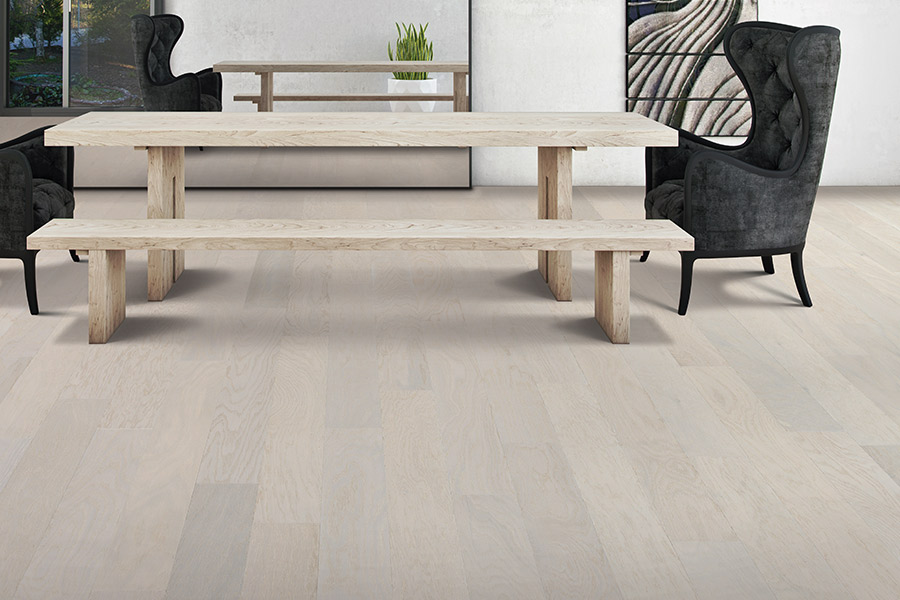
Oak is the default for good reason. It is hard enough for family traffic, its open grain disguises minor wear, and it accepts stain more predictably than almost any other species — which matters when a whole-house scheme has to stay coherent while cabinet and wall colours are still being finalised. Red oak runs warmer, with a pinkish undertone. White oak has a tighter grain and a cooler, more neutral base, which is why it dominates current design and works particularly well with the pale, natural palettes common in Los Angeles interiors.
Hickory
Hickory is among the hardest domestic species widely available, and it carries dramatic colour variation from board to board. That variation is an asset in a busy hallway, an entry or a staircase, where it hides scuffs and dents that a uniform floor would advertise. In a small room it can read as visually noisy, so it rewards being seen at scale before committing.
Maple
Maple has a fine, subtle grain and a clean contemporary look. It is hard, but its smooth closed grain shows dents and scratches more readily than oak does, and it is less forgiving with stain — it can absorb unevenly and blotch. It is a strong choice in a light, minimal scheme where the floor is meant to recede.
Other Species Worth Considering
The wider hardwood range also includes acacia, ash, birch, walnut and cherry among others. Acacia brings strong figure and warmth. Ash resembles oak with a lighter, straighter grain. Walnut is rich and dark but softer underfoot than oak, which makes it a better fit for a formal room than a mudroom. You can filter the catalog by species, and any product can be ordered as a sample with free shipping so you can see it in your own light before deciding.
What Should You Look At on the Spec Sheet?
Product names tell you almost nothing. These four attributes tell you nearly everything, and all of them are filterable in the catalog.
- Wear layer thickness. On engineered hardwood, this is the depth of real timber above the core, and it governs whether the floor can ever be sanded and refinished. A thinner wear layer is perfectly sensible in a rental or a property that will be refreshed on a ten-year cycle. It is the wrong specification for an owner who expects to refinish rather than replace.
- Core construction. Multi-ply plywood cores generally hold fasteners well and tolerate wider planks. High-density fibreboard and rigid cores are more dimensionally stable and often more affordable. Both perform in Los Angeles; they simply fail differently, and the core dictates which installation methods the manufacturer will permit.
- Installation method. Floating, glue down, nail down and staple down are not interchangeable, and any given product allows only some of them. Over a slab your realistic options are floating or glue down. Check this before falling for a colour.
- Finish and gloss level. Factory-applied finishes are cured under controlled conditions and are generally more durable than a finish applied on site. Gloss level is covered in more detail below, and in Los Angeles it matters more than most buyers expect.
Two further flags are worth checking on the individual product page. If the project has any form of underfloor heating, confirm radiant-heat approval on that specific product rather than assuming the collection allows it. And if the floor is going anywhere near moisture, check the water-protection rating — only a small portion of any hardwood range carries one, and for genuinely wet areas a rigid-core SPC or WPC product is the more sensible specification.
How Is Hardwood Installed?
Four methods are in common use, and the hardwood range at Mill Sales includes products approved for each of them.
- Planks lock to one another and rest on an underlayment rather than being fixed to the subfloor. Fast, forgiving of minor subfloor variation, and the usual choice over concrete.
- Glue down. Planks are bonded directly to the subfloor with a flooring adhesive. Gives the most solid feel underfoot and the best acoustic result over a slab, and is frequently specified in condominiums for that reason.
- Nail down and staple down. Planks are mechanically fastened to a wood subfloor. Traditional, excellent, and only available where there is a wood subfloor to fasten into.
Whichever method the product allows, two steps before installation determine whether the floor lasts. The slab or subfloor must be tested for moisture — in-situ relative humidity probes (ASTM F2170) and the calcium chloride test (ASTM F1869) are the two methods manufacturers recognise, and the acceptable limit comes from the specific product and adhesive rather than from a universal figure. And the material needs to acclimate in the space it will live in, for the period the manufacturer specifies.
The other half of the job is everything that never appears on a selection sheet: adhesive, underlayment, levelling compound, moisture mitigation, transition profiles and trim. A correct floor installed over an uncorrected subfloor fails as reliably as a poor floor. We stock flooring sundries alongside the flooring itself, so the materials your installer needs can be quoted and collected with the same order rather than chased separately.
Which Finish and Surface Texture Work Best in Los Angeles Light?
This is where local conditions matter most, and where a decision made from a showroom sample under artificial light often disappoints at home.
Gloss is a liability here. A high-sheen finish reflects the strong, direct light this city gets for most of the year, and in doing so it highlights every particle of fine dust, every scuff and every micro-scratch. Matte and low-sheen finishes disguise all three, and they are the reason two identical floors can generate completely different maintenance complaints in the first year.
Surface texture works the same way. A wire-brushed surface has had the softer grain gently scraped out, leaving fine texture that hides day-to-day wear remarkably well — the single most practical choice for a household with children, pets or heavy traffic. Hand-scraped surfaces carry heavier, more decorative character marks. Smooth surfaces look sharpest and show the most.
Finally, plan for sun. Every wood floor changes tone under sustained ultraviolet light; some species shift dramatically. Window film, blinds and rotating rugs and furniture through the year all slow it down, and choosing a floor whose natural colour you would still be happy with a few shades along is the most reliable protection of all. Our guide to protecting hardwood floors from Southern California sun covers this in more depth.
Does Plank Width Matter?
Wide-plank flooring has been the dominant look in Los Angeles interiors for years, and it does genuinely change how a room reads — fewer seams, a calmer floor, a more expansive feel in open-plan spaces. It also demands more of the material, because a wider board has more width across which to move when humidity changes.
This is the clearest practical argument for engineered construction. A wide engineered plank stays flat in conditions where a wide solid board would cup or gap, which is why nearly all wide-plank flooring sold for slab construction is engineered. If you want the wide-plank look in a Los Angeles home, engineered is not a compromise on that ambition — it is what makes it work. Narrower strip flooring, by contrast, suits period properties where the original floor was narrow and a wide board would look anachronistic.
Can Hardwood Be Used in Commercial and Multi-Family Projects?
Yes, and a meaningful portion of the hardwood range carries a commercial rating. Wood works well in boutique retail, offices, restaurant fronts of house, hospitality lobbies and multi-family amenity spaces where the material is doing real work in the design. The practical considerations are traffic volume, refinishing access on an occupied site, and acoustic performance in a multi-storey building.
It is not always the right answer, and part of specifying well is knowing where something else does the job better. In corridors, leasing offices and shared circulation, commercial carpet and carpet tile usually deliver better acoustics and far easier repair — a damaged tile is replaced individually rather than triggering a full reinstall. Our carpet guide covers those options. And for genuinely wet areas — laundry rooms, ground-floor entries, unit bathrooms — a waterproof rigid-core product is the correct specification rather than wood.
On any California project, remember that engineered hardwood cores are composite wood products and fall under the state’s low-formaldehyde emission requirements. Ask for the compliance documentation at quotation stage and keep it with the product data sheet; chasing a certificate after delivery is an avoidable delay.
How Do You Care for Hardwood Floors in Southern California?
Hardwood is not difficult to look after, but it is unforgiving of the wrong routine. Three rules cover most of it.
- Keep it dry. Dust-mop or vacuum with a hard-floor setting regularly, and clean with a cleaner approved by the floor’s manufacturer. Never steam-mop a wood floor and never wet-mop one; water in the seams is the most common self-inflicted damage there is.
- Stop the damage cleaning cannot fix. Felt pads under every furniture leg, mats at every exterior door, and prompt attention to grit — which is abrasive and does more harm underfoot than anything else that enters the house.
- Manage the light and the air. Rotate rugs and furniture through the year so the floor ages evenly, and avoid letting indoor humidity swing to extremes during long dry spells.
Our guide to cleaning and maintaining hardwood floors in Los Angeles sets out a fuller routine, including how to tell when maintenance has become a replacement conversation.
Where Can You Buy Hardwood Flooring Wholesale in Los Angeles?
Mill Sales is a wholesale flooring supplier in Downtown Los Angeles. We buy direct from leading manufacturers and we also buy closeouts and discontinued lines, which is how the pricing works — and knowing which of those two channels suits your project is worth a moment’s thought.
Closeout and discontinued material is an excellent fit when the whole quantity can be secured at once: a single home, a defined block of unit turnovers, one phase of a build. You get quality goods at a price that would otherwise be out of reach. It is the wrong fit when you will need to reorder the same product in eighteen months or match a repair later, because by then the line has gone. For phased and repeatable work, direct-from-manufacturer inventory is the answer.
Either way, material already sitting in a Downtown Los Angeles warehouse behaves differently on a schedule from material that has to be freighted in after the order is placed. Our counter keeps trade hours rather than retail ones — mornings through mid-afternoon on weekdays and Saturday mornings — because that is when contractors and installers actually collect.
We supply homeowners, landlords, contractors, installers, property managers and investors, and the buying process is built to work without a showroom trip for every decision. The online catalog is open around the clock and filters down to the exact construction, species, installation method and application you need. Samples ship free. Featured products can be previewed in your own room before you order. And project financing is available through a lending marketplace, with pre-qualification that does not affect your credit score.

Browse Hardwood at Mill Sales
The full hardwood catalog can be filtered by construction, species, installation method, surface texture and application, and every product can be ordered as a free sample. If you would rather talk it through — whether that is one room, a whole house or a portfolio of units — we will help you narrow it down and price it properly.
Get in touchFeatured Hardwood
Frequently Asked Questions
Yes. The wear surface of engineered hardwood is genuine sawn timber — the same species, grain and finish you would get on a solid board. The difference is underneath, where a cross-laminated core replaces the rest of the solid timber to keep the plank dimensionally stable.
Engineered hardwood can, using either a floating or a glue-down method, provided the slab passes a moisture test to the manufacturer’s limit. Solid hardwood cannot be fixed directly to concrete; it needs a built-up wood subfloor first.
The surface durability is the same, because the surface is the same material — it depends on species and finish, not construction. Solid hardwood lasts longer overall because it can be refinished more times. Engineered hardwood performs better in conditions where humidity moves, which describes most of Southern California.
Among widely available species, hickory sits at the harder end and oak is close behind while being easier to stain evenly. In practice, a wire-brushed surface and a matte finish will do more to keep a floor looking good than an extra few hundred points of hardness.
Some colour change is normal in every wood floor exposed to strong light, and Los Angeles delivers a great deal of it. Window film, blinds and rotating rugs and furniture slow the process. Choosing a tone you would still be happy with a few shades along is the most dependable approach.
Kitchens are usually fine with prompt spill cleanup and a good finish. Full bathrooms and laundry rooms are not a good application for wood — a waterproof rigid-core product is the right specification for standing-water risk.
Yes. We supply trade customers alongside homeowners, with wholesale pricing, in-stock material at our Downtown Los Angeles warehouse and trade counter hours.
Order enough to cover the area plus a waste allowance for cuts, and put aside attic stock from the same production run for future repairs. Dye and grade variation between runs is real, and a matching board is impossible to source once a line is discontinued.
Reimagine your space
Get inspired with our beautiful flooring galleries

1215 W 6th St, Los Angeles, CA 90017 | (213) 482-3005


Copyright © 2026 Mill Sales | Privacy | Accessibility