

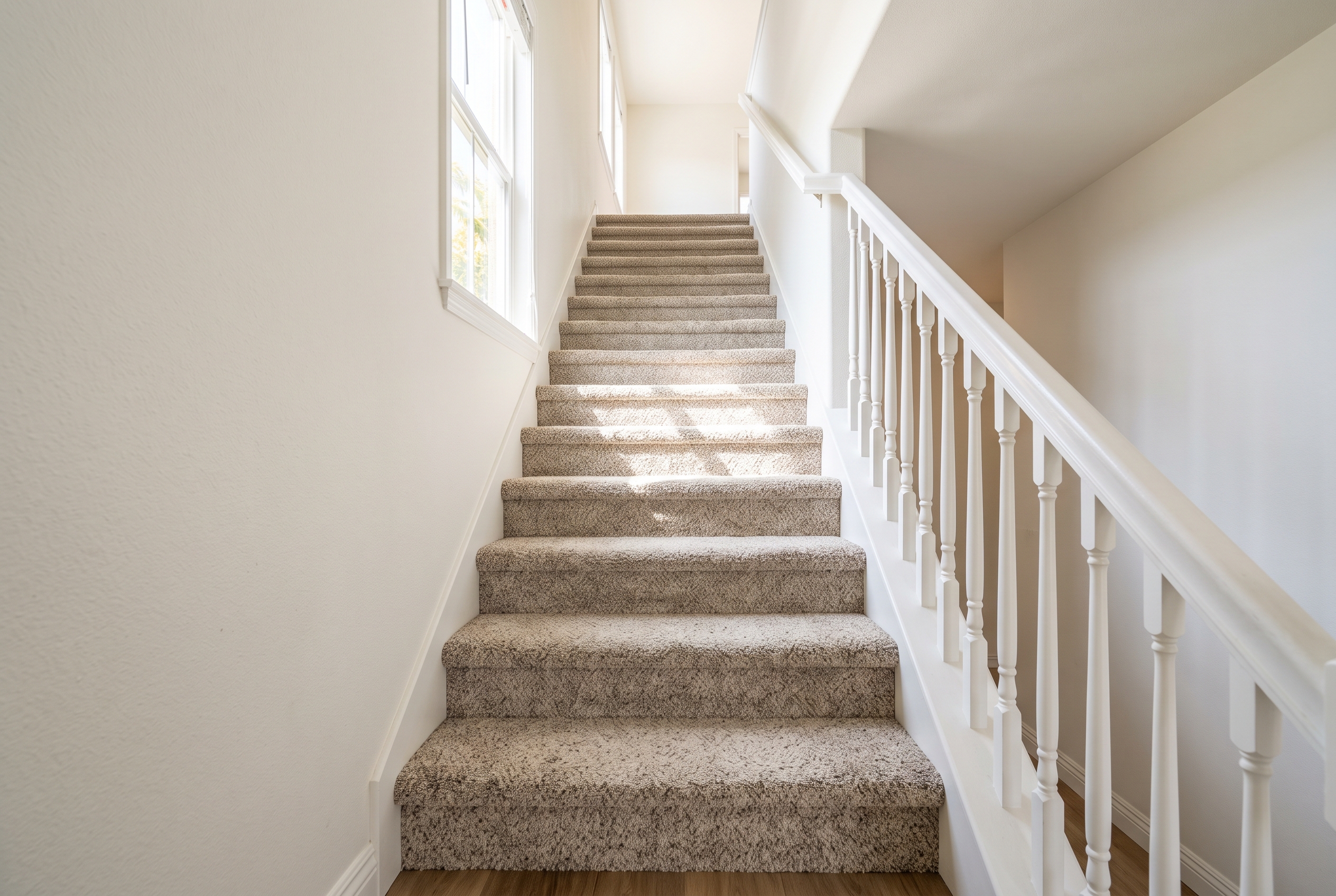
The carpet that lasts on stairs is short and dense: a textured or patterned cut pile in nylon or triexta, with a tight twist, in a mid-tone that hides the path everyone walks. It goes over a thin, firm cushion. A loop or Berber belongs on stairs only when a sample folded over a stair edge stays closed.
| Your stairs | What to buy | Why |
|---|---|---|
| Busy family, everyday traffic | Dense textured or patterned nylon | Springs back and hides the traffic path |
| Dogs or cats | Cut pile in nylon or triexta | No loops for claws; resists stains |
| Rental or turnover unit | Mid-tone patterned nylon, one style | Wears well; patches from spare stock |
| Quiet stairs, light use | Polyester or wool that passes the fold test | Softer underfoot; traffic is light |
| Runner over wood treads | Low, dense cut pile or flat loop | Grips the nose; bound edges hold |
Why Stairs Wear Out Carpet First
Carpet on stairs wears faster than carpet anywhere else in the house, because every step lands on the same few inches and pushes off the same edge. On a floor, traffic spreads across the room. On a staircase, each foot lands on the front of the tread and pivots over the nose, the rounded front edge of the step, so the wear concentrates in one band per step.
The nose does the most damage. Carpet bent over it opens up, exposing the base of the tufts to grit and to the scuff of every heel going down. Stair carpet usually shows wear at the nose first, with the tread behind it flattened and the riser still looking new.
Each of those wear points has a matching feature to look for. Density gives the pile less room to open at the nose, and a tight twist keeps the yarn ends from blooming and fraying. A low pile has less to crush, and a color with some variation in it hides a traffic path for years.
Cut Pile, Loop or Berber on Stairs?
For most stairs, a textured cut pile or a cut-and-loop pattern is the safe choice, and a loop or Berber works only once it passes the fold test. Plush, smooth cut piles like saxony look beautiful on the first day and show every footprint and every crushed spot by the end of the year.
Textured cut pile, sometimes sold as trackless, has its yarn ends twisted and set at slightly different angles, so footprints and shading disappear. Cut pile carpet with a tight twist is the everyday stair carpet.
Cut-and-loop patterns, where some yarn is cut and some is looped, hide wear and soil even better, because the eye reads the pattern before it notices the traffic. Patterned carpet runs to more than 4,500 colors in our catalog, and a patterned carpet in a mid-tone is where we'd start for a busy staircase.
Loop carpet is tough on a flat floor, and on stairs it has two catches. A loop folded over a sharp nose can open so the backing shows between the rows, which the trade calls grinning. Loops can also catch claws and snag. A dense, low level loop on well-rounded noses in a house without pets can be a fine stair carpet; a chunky Berber on square-edged stairs usually isn't.
The Fold Test for a Stair Sample
The fold test tells you in a minute whether a carpet will grin or open up on your stairs, and a free sample is all it takes.
- Fold the sample over a stair nose, or over the edge of a table, with the pile facing out.
- Look along the fold in good light. If you can see the backing between the tufts or loops, the carpet will grin on your stairs.
- Run your hand along the fold. If the tufts splay open or feel loose, the carpet will open up at every nose.
- Press the face flat with your thumb and let go. A carpet that springs back quickly will recover from feet on the treads.
A carpet that stays closed on the fold and springs back is a stair carpet. One that grins is a bedroom carpet, however much you like the color.
Best Carpet Fiber for Stairs
Nylon is the best carpet fiber for most stairs, because it recovers from crushing better than any other mainstream fiber, and recovery is what a staircase tests hardest. Under feet, nylon springs back after being compressed where polyester stays flat. It's also the largest fiber group in our carpet, with about 4,800 colors of nylon carpet for stairs and halls.
Triexta, a newer synthetic fiber, is the other strong choice for stairs. Its stain resistance is built into the fiber, so it doesn't wear off, and it recovers better than polyester, which makes it a favorite for stairs with pets. We carry triexta and triexta blends in about 2,500 colors.
Polyester, PET included, is soft, holds color well and resists stains, though it doesn't recover from crushing the way nylon does. It suits stairs that see little traffic, like the stairs to a guest suite, more than the main staircase of a family house.
Opinions split on wool for stairs. It's naturally resilient and soil-resistant, and a dense, tightly made wool is a beautiful stair carpet, but it's also the most expensive fiber, and a loose, chunky wool loop will grin and fuzz on the noses. If you love wool, choose a dense, low one and put it through the fold test; wool carpet in dense, low constructions is part of a wool range of more than 500 colors.
Olefin, or polypropylene, shrugs off moisture and fading but crushes sooner than nylon, so it suits a basement or a patio room better than a staircase.
A sunny stairwell changes the choice. A staircase under a west window or a skylight takes direct Los Angeles sun every afternoon. Solution-dyed fibers, colored all the way through before they're spun, hold their color far better in that light than fibers dyed after the carpet is made.
Density, Twist and Pile Height for Stair Carpet
Density, twist and pile height, printed on the back of a carpet sample, tell you more about how it will wear on stairs than the brand or the price. Face weight is printed there too, and it's the one to read last.
| On the sample | For stairs, look for | Why |
|---|---|---|
| Twist | About 5 or higher on cut pile | Tight yarn resists fraying at the nose |
| Density | Higher, compared within one maker | Packed pile opens less over the nose |
| Pile height | About 1/2 inch or less | Less to crush; steadier footing |
| Face weight | Read it with density | Tall pile inflates it |
Twist is the number of turns in each tuft per inch of yarn. A tighter twist holds the yarn end together, so it doesn't bloom and fray after being bent over a nose thousands of times. Most of the carpet we carry that lists a twist rating sits at 5 or more.
Density is how tightly the yarn is packed, and it's the best single predictor of how a carpet will hold up on stairs. Makers don't all calculate it the same way, so compare density between carpets on the same maker's spec sheets.
Face weight is the ounces of yarn per square yard. It sounds like quality, but a tall, loose pile can carry a high face weight and still crush on the first stair. Two carpets of the same face weight, one half an inch tall and one an inch, will wear very differently on a staircase.
You can shortlist by all four at once: our carpet filters by twist, density, face weight and pile height, along with fiber and construction.
Colors and Patterns That Hide Stair Wear
If the stairs carry the whole household up and down every day, choose a mid-tone with some variation in it: a heathered, flecked or tweed color, or a small pattern. These hide the traffic path, lint and the soil that collects at the nose. Very light colors show the path within months, and very dark solids show lint, pet hair and sun fade.
Look at samples on the stairs themselves, at the time of day the stairs get their light. A staircase is usually lit from one side or from a skylight, so a color that looks warm in your hand can look gray in the stairwell.
Carpet Cushion for Stairs
Stair cushion should be thin and firm. The Carpet and Rug Institute's residential installation standard, CRI 105, caps residential cushion at 7/16 inch. It also requires the cushion the carpet's maker specifies, and on stairs the thin, firm end of what the maker allows is the right choice.
Thickness works against a stair carpet. A soft, thick cushion lets the carpet flex over the nose with every step, which opens the pile and wears it faster, and it makes the edge of the step feel vague underfoot. A firm cushion holds the carpet tight around the nose and gives the foot a definite edge.
The cushion extends over the nose, protecting the carpet where it bends. The maker's cushion spec matters for more than comfort, because the same standard notes that the wrong cushion can void the carpet's warranty. Follow the specification printed with the carpet.
Waterfall or Hollywood Stairs
Waterfall stairs let the carpet fall straight from the nose to the next tread down, leaving a small space under the nose. Hollywood stairs, also called cap-and-band or upholstered, wrap the carpet tight under each nose so the shape of the step shows. Waterfall is quicker and works with almost any carpet; Hollywood looks tailored and suits thinner, flexible carpets that bend tightly.
In CRI 105's terms, a waterfall install fastens the carpet on both the tread and the riser, while a cap-and-band install fastens the tread and wraps the riser without a strip on it. Upholstered work leaves no raw edges showing.
Either way, the pile runs down the stairs. The standard has the carpet's manufacturing direction running the length of the staircase and notes that the pile should point toward the bottom step, which keeps the noses from looking worn as people walk down.
Check the noses before choosing a style. The standard wants each nose rounded to a radius of 3/4 to 1 inch, because a sharp edge cuts carpet and cushion. Bullnose bottom steps and open-sided stairs, where the carpet wraps around the end of the tread, take extra carpet and extra labor in either style.
How Much Carpet You Need for Stairs
To work out how much carpet a staircase needs, measure one step and the stair width, then see how many step pieces fit across a 12-foot roll. Carpet comes off the roll 12 or 15 feet wide, and the roll width sets how much you pay for on a staircase just as it does in a room.
- Measure the tread depth, from the riser to the front of the nose, and the riser height. Add about an inch to wrap the nose, and another inch for a Hollywood stair.
- Measure the width of the stairs, wall to wall or from the wall to the spindles.
- Each step is one piece, the stair width wide and the step measurement deep. The pieces are cut across the roll with their depth running along it, so the pile runs down every step.
- Divide 144 inches, the width of a 12-foot roll, by the stair width to see how many steps fit across one strip, then count the strips the flight needs.
- Measure landings and winders separately. A landing is its own piece, and pie-shaped winder steps waste more.
| 13 steps, 19-inch pieces | 36-inch stairs | 42-inch stairs |
|---|---|---|
| Steps per strip of a 12-ft roll | 4 | 3 |
| Strips needed | 4 (16 pieces) | 5 (15 pieces) |
| Roll length | About 6 ft 4 in | About 7 ft 11 in |
| Carpet to buy | About 8.4 sq yd | About 10.6 sq yd |
The steps themselves cover less than that. Thirteen 36-by-19-inch pieces come to about 6.9 square yards, and the rest is the cost of cutting from a 12-foot roll. With carpet running about $1 to $5 a square foot nationally for the material, the 8.4 square yards for a 36-inch flight, about 76 square feet, is roughly $75 to $380 of carpet before cushion and labor.
A landing adds its own cut. A 3-by-3-foot landing takes a 3-foot length across the roll, about 4 square yards, and the rest of that length gives you more step-sized spares.
The extra pieces that cutting leaves are spare steps, and two or three of them are worth keeping. Stair noses wear before anything else, and a spare piece from the same roll replaces a worn step without a mismatch. If the stairs match the carpet upstairs, buy both from the same roll so the dye lot matches too.
Stair Runner or Wall-to-Wall Carpet?
A runner suits hardwood stairs in good shape that you want to show; wall-to-wall suits treads that are plain or worn, and any stair where softness, quiet and grip matter most. A runner covers the center of each step and leaves wood showing at the sides, while wall-to-wall covers everything.
A runner is cut from broadloom or bought as runner goods, and its edges are bound or serged so they don't fray. Leave about 3 to 4 inches of wood showing on each side: a runner that's too narrow looks like a mat, and one too wide crowds the balusters. Most runners need 20 to 25 linear feet for a straight flight, fastened at every step, with stair rods as an option for a traditional look.
A flat, dense carpet that grips the nose makes the best runner, because binding makes a thick carpet look clumsy. Wall-to-wall carpet costs less per step than a good runner, it's quieter, and it covers worn or mismatched treads. On a staircase with spindles, wall-to-wall has to be cut around each one, which adds labor.
Safer Carpeted Stairs
Safer carpeted stairs start with a low, dense pile over a thin, firm cushion, fastened tight on every step. Together they keep the foot square on the edge of each tread, which is where a slip starts, so they matter most when someone in the house is unsteady on their feet.
A thick, soft pile rounds over the nose and hides where the step ends, and a soft cushion lets the foot roll forward. A low, dense carpet keeps the edge crisp. Contrast helps older eyes too: a pattern or a mid-tone that makes each nose visible is safer than a pale solid that turns the flight into one smooth slope.
Loose carpet is the hazard to fix right away. If a stair carpet has come away from the nose, ripples on the tread or lifts at the edge, have it re-stretched and re-fastened before someone catches a toe in it. Loose mats and stick-on treads that have lost their grip belong off the stairs.
Carpet for Stairs With Dogs and Cats
If a dog or cat uses the stairs, choose a cut pile in nylon or triexta, in a mid-tone with some flecks. Claws catch in loops and pull them, and a snag on a stair nose can run along the whole edge.
Triexta's built-in stain resistance and nylon's recovery both suit pets. A flecked or heathered color hides hair between vacuumings, and a pattern hides the wear a dog's daily climb leaves on the noses.
Keep nails trimmed, and vacuum the stairs with a hand tool or a crevice nozzle along the back of each tread and over the nose, where hair collects. Blot accidents straight away with clean water and a white cloth, working from the outside in, because a stain left on a nose gets walked into the pile by everyone going downstairs.
Carpet for Rental Stairs
For rental stairs, choose a dense patterned or textured nylon in a mid-tone, and use the same style across the units you manage. Stairs take the most wear in a rental and usually need replacing before the bedrooms, so a single style means spare step pieces from one roll can patch any unit.
Polyester is the tempting saving, and on one flight it's a small one. A 13-step flight takes about 76 square feet of carpet, and at national material prices of roughly $0.75 to $9 a square foot for nylon and $0.50 to $6 for polyester, the difference comes to somewhere between $20 and $230. Replacing the stairs a cycle early costs more than that.
Replace the stairs on their own cycle, not when the whole unit looks tired. Keep a few spare step pieces from each roll, labeled with the unit and the date, so a single worn step can be swapped between tenants.
What Carpeting Stairs Costs
HomeGuide's national cost guide puts carpeting stairs at about $15 to $55 per step installed, or $180 to $880 for a straight flight of 12 to 16 steps. That breaks down to about $5 to $25 a step for the carpet, $4 to $10 for the cushion and $6 to $20 for the labor.
| For 13 straight steps | National range |
|---|---|
| Carpet, cushion and installation | $200 to $720 |
| Removing old stair carpet | $7 to $10 a step |
| Carpeting a landing | $50 to $100 more |
| Cutting around spindles | $10 to $20 a step more |
| A runner instead, installed | $500 to $2,000 |
The carpet is the line that moves most, from builder-grade polyester to wool. Shape moves it too: L-shaped, U-shaped, curved and spiral stairs all cost more than a straight flight, because each piece takes more cutting. A runner costs more per step than wall-to-wall because of the binding and the fitting.
When the stairs are part of a bigger project, a loan through our lending marketplace can cover the whole job, and pre-qualifying won't touch your credit score.
When Stair Carpet Wears Out
Worn stair carpet shows at the nose first: the pile is flattened or bald along the front edge, the backing shows when you look down the flight, or the color has gone gray where everyone steps. At that point the stairs need new carpet, even if the rest of the house doesn't.
Grinning on a newer carpet, with backing showing along the noses, means the carpet was too open for stairs or the noses are too sharp, and those gaps don't close again. The fix is a denser carpet, with square noses rounded first.
Ripples, loose treads and carpet pulling away from the nose mean the carpet has lost its grip on the tack strip, and re-stretching and re-fastening fixes that. Frayed sides, where the carpet meets the wall or the spindles, mean the edges weren't sealed or turned under. Once they unravel, the step needs replacing.
You can replace the stairs alone. Spare pieces from the original roll will match. Without them, choose a carpet that coordinates instead of one that nearly matches, and let it change at the top nose or the landing, where a change looks intentional.
Stair Carpet From Our Warehouse
At Mill Sales, we carry stair carpet from 14 makers, Shaw, Mohawk, Masland, Anderson Tuftex, Dream Weaver and Godfrey Hirst among them, in our Downtown Los Angeles warehouse. Nylon is the largest fiber group in our carpet, triexta and wool are well represented, and textured and patterned styles run to thousands of colors.
You can narrow a stair carpet by fiber, construction, twist, density and pile height online, then order samples, which ship free, and run the fold test on your own stairs. Once two or three have passed, we price your stairs and rooms at a free in-home estimate. Our counter on West 6th Street is open weekdays from 8:00 to 3:00 and Saturday mornings from 8:30 to noon.
Questions About Carpet on Stairs
Should Stair Carpet Match the Upstairs Carpet?
It usually should when the stairs open onto a carpeted landing and hall, because one carpet reads as one floor and a change halfway looks like a patch. When the stairs meet hardwood or tile at the top, a different stair carpet looks fine. If you do match, buy both from the same roll.
Can You Put Carpet Tiles on Stairs?
No, not as a fitted stair covering. Carpet tiles are made to lie flat with their edges butted together, and they can't wrap a nose or hold an edge on a step. Individual stick-down stair treads are a different product, made to sit on wood stairs.
How Long Does Carpet Last on Stairs?
Carpet on stairs wears out sooner than the carpet in the rooms it connects, because the wear is concentrated on the noses. Plan on replacing the stairs before the bedrooms, expect a dense nylon to outlast a loose polyester by a wide margin, and use spare pieces from the original roll to replace the worst steps first.
Can Carpet Go Over Existing Hardwood Stairs?
Yes, as wall-to-wall carpet or a runner, fastened with tack strip and staples. Check that the noses are rounded first, since a square wood edge cuts carpet, and know that the fasteners leave small holes in the wood if the carpet ever comes up.
Bring Home a Sample and Try the Fold Test
Two or three samples folded over your own stair noses will tell you more than any spec sheet, and the fold test costs nothing. When you've found the carpet that stays closed and springs back, book a free in-home estimate and we'll price the stairs.


